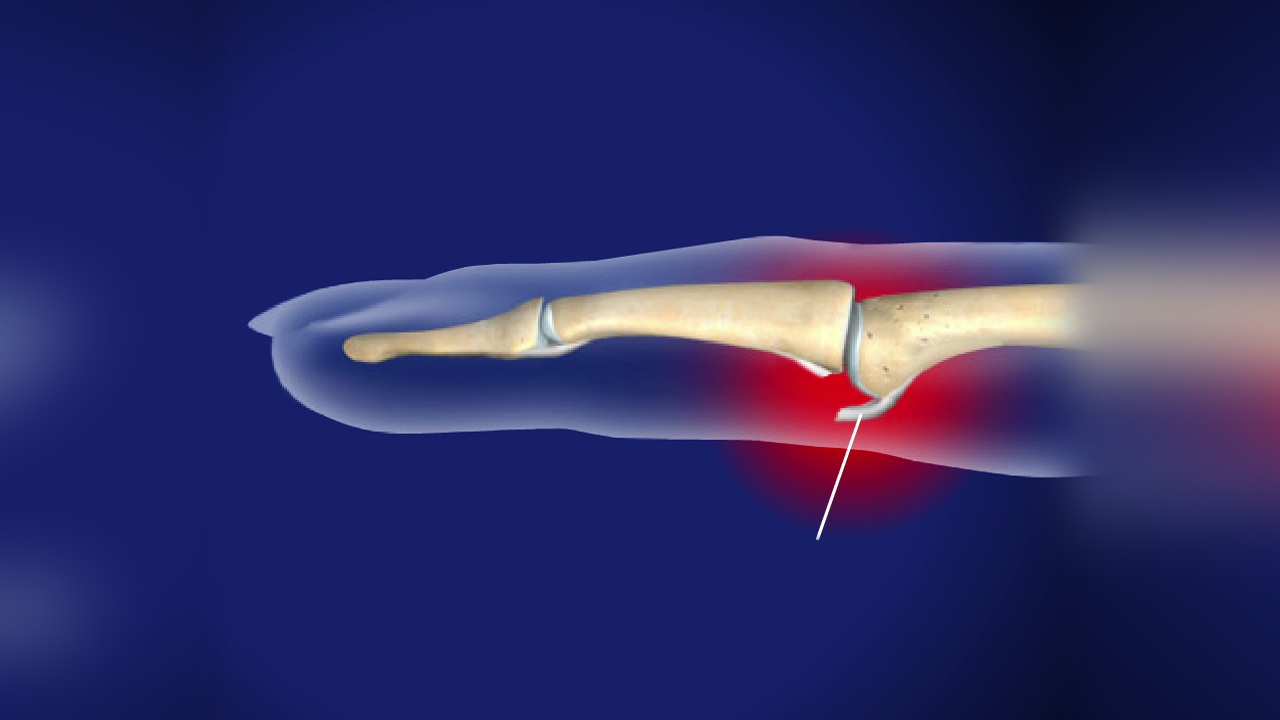
Ligament injury to the finger's middle joint — from dislocation or hyperextension. Often dismissed as a simple sprain, but specialist assessment guides the right treatment.
The volar plate is a thick ligament on the palm side of the proximal interphalangeal (PIP) joint — the middle joint of the finger. It prevents the joint from hyperextending and provides important stability to the finger.
Volar plate injuries typically occur when a finger is forcefully hyperextended or dislocated — common in ball sports such as football, basketball, and cricket. They range from minor sprains to fracture-dislocations involving a bony fragment. Although often described as "just a sprain", inadequately managed volar plate injuries can result in persistent instability, stiffness, or a swan neck deformity.
Symptoms
Pain and swelling over the middle finger joint (PIP joint)
Difficulty bending or straightening the finger
Joint instability — a feeling that the finger is "loose"
Bruising along the palm side of the finger
History of finger dislocation or hyperextension injury
In fracture-dislocation: a bony lump or visible deformity
Diagnosis
How it is diagnosed
Clinical examination of joint stability in flexion and extension
X-ray (PA and true lateral views of the finger) to exclude fracture or dislocation
Stress views to assess collateral ligament involvement
MRI or ultrasound in cases of persistent instability or complex presentation
Treatment
When to consider surgery
Most volar plate injuries are managed conservatively with a dorsal blocking splint that permits safe flexion while protecting the healing ligament, followed by guided hand therapy. Surgery is required for fracture-dislocations where the joint cannot be maintained in a stable position, for large bony fragments, or for chronic instability. Surgical options include open reduction and internal fixation (ORIF) of the fragment or volar plate advancement.
Dorsal blocking splintHand therapyDay surgery if neededEarly mobilisation
Typical recovery Conservative management: splinting for 3–6 weeks followed by hand therapy. Most patients regain good function, though some residual swelling and mild stiffness can persist for several months. Surgical cases: protected mobilisation after fixation, with therapy beginning within days. Full recovery typically takes 3–6 months and varies with severity.
Seek specialist assessment if: Any finger dislocation — even if it "went back in" — should be assessed. Persistent instability, a finger that cannot be held straight, or a visible bone fragment on X-ray all warrant specialist review. Early assessment prevents stiffness and long-term joint problems.
Dr Ma consults at Chatswood (Healthpac Medical Centre, Level 1/7 Help St) and Strathfield (Strathfield Private Hospital). Call (02) 8112 8569 or book online.
Frequently asked questions
No. Most volar plate injuries heal well with appropriate splinting and hand therapy. Surgery is reserved for fracture-dislocations where the joint cannot be held in position conservatively, large bony fragments, or instability that persists after splinting.
A dorsal blocking splint is typically worn for 3–6 weeks, depending on the severity of the injury. The splint holds the finger in slight flexion to protect the repaired ligament while allowing controlled movement.
A dorsal blocking splint is applied to the back of the finger to prevent it straightening fully while still allowing a safe arc of flexion. It protects the volar plate during healing and is the cornerstone of conservative management.
Finger stiffness is a common issue after sustaining a volar plate injury. Early controlled movement guided by a hand therapist is important to prevent the joint from becoming stiff while the ligament heals. Delays in starting rehabilitation can make stiffness harder to resolve.
A GP referral is recommended for Medicare rebates but not required to book.